Sunday, April 29, 2012

The 3rd Building on CGF Arrives!

As many of our blog followers might know, we purchased our farm about 4 years ago with absolutely nothing on it except trees, grasses, and massive ant hills. We have come along way since we first broke ground here, but we still have quite a bit of set up to do! 

One of the things that we are much in need of is more structures.  We have our house and our open face shed that we built, but that is it.  With all of our different livestock, we really would like more buildings.


About 1/2 mile away, on the top of the hill on an old farmstead, we saw this old 12 x 20 grain building.  We contacted the owners of the land, met with them and enjoyed hearing the history of the farmstead, and we were given permission to purchase and move the building.

Since it was built with 3 skids, which had been resting on concrete, it would have been a simple-ish task to move it to our property after a good snow, pulling it behind our tractor. But alas, we didn't have much snow this winter and it is now almost May.  So we did the next best thing. Ethan got ahold of his cousin, who also farms and can do about anything - and who has a grate trailer and an assortment of tractors, and requested some help.

I trailed behind with the camera to capture the process.  Here's my best attempt.
*You can click on the photos to enlarge them.


Ethan and Verne hooked up the front corners of the building with chains to the loaders of 2 4020 tractors.  They then lifted up the front of the building.


Verne backed the trailer under the building. (The trailer had some steel extensions on the bed so the skids would have support on them.)

Next, the building was hooked up to the winch.  This would have easily pulled the building up onto the trailer . . . except the winch wasn't getting power from the batteries or something.  I didn't ask!


So plan B - Pull both tractors parallel to the trailer, hook them up again to the corners of the building, and back the tractors up to pull the building onto the trailer.


 Now, the large, heavy building somewhat was on pivot point being pulled on different corners by 2 tractors.  All I will say is that it is a bit tricky to reverse at the same rate with 2 different tractors, and I was glad with the building was on the trailer and sitting still!


After the building was on the trailer, I had to take off to town with our kiddos for our home school coop.


Ethan said that they then chained the building to the trailer and headed down the road.


The 1/2 mile drive was uneventful, and they pulled up into our pasture behind the house.


Unloading the building seemed to be a bit easier, although pulling the building off with the tractor didn't seem to be the best way to go power wise.  They kept the tractor chained up, though, and just pulled the trailer ahead. The weight of the tractor seemed to do the trick as the trailer pulled ahead, and the building slid off the back.  Just before the last part of the building came off the trailer, they once again hooked the building up to both tractor loaders to hold it in the air while they finished pulling the trailer out, and then they gently lowered the end of the building to the ground.

So now we have another building here!  We have a bit of work to do before we use it though.  First off - we discovered that it came with honey bees in the walls! Thankfully we have a bee keeping friend who is excited to capture the colony for a hive.  We then need will need to reside it to keep it tight.  We need to make it predator safe since we plan on brooding some chicks in one of half of it. (There is a full wall in the middle, dividing the building in half.)  And lastly, before we pull it to its permanent location, we want to put some lengths of cement down to help it be level and stay off of the ground.  Since we will be putting a bit of work and some money into it, we want it to last a long time! 

So there you have it!  Hopefully I can get some pictures and posts of the bee extraction and fixing up of it. I'm sure excited to put it to use though!

Monday, April 9, 2012

Asparagus and Fruit!

If you know Ethan and myself well, you will know that he is the meat guy and I am the fruit and vegetable gal.  Ethan would be perfectly happy to only eat meat - and never fruits or vegetables.  And although I do enjoy smaller portions of good meat, I would be perfectly happy to live off of fruits and vegetables.

Our farm is definitely a meat farm.  There's no getting around that.  But, I would love to take my love for fruits and vegetables - eating, growing, and preserving them, and add a little bit to the farm as well. Since these things aren't the main focus of the farm (read - our money and time need to go into the meat aspect of the farm right now), the fruits and veggies are going to need to be added slowly.  This year I've made some steps ahead though!

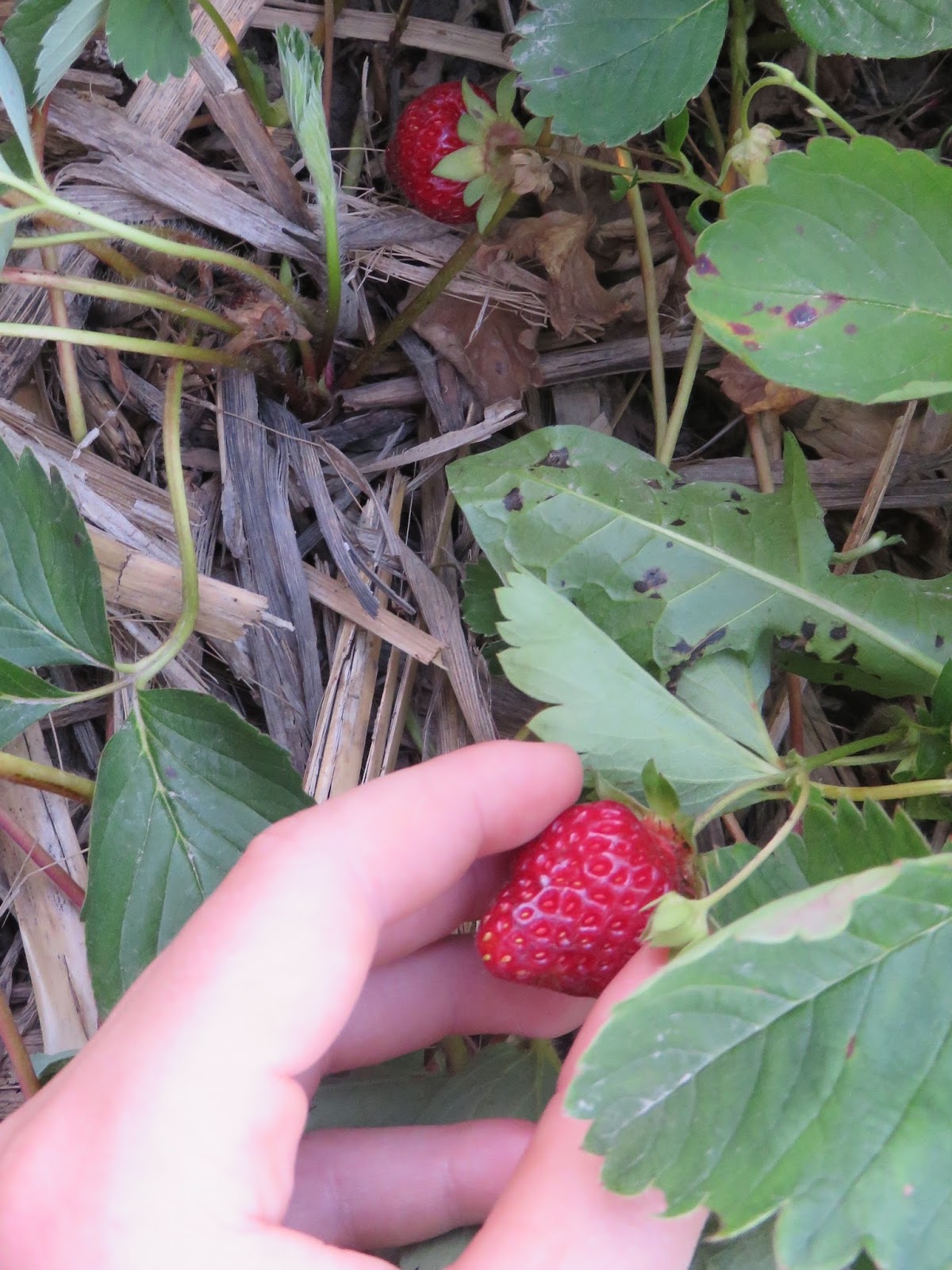
Along with my orchard, I finally got a nice row of black raspberries to winter over from moving starts up from the woods.  My brother dug up a rhubarb plant he didn't want from his new house - I divided around 60 roots from this plant!  I am also receiving some additional strawberry plants from my mom and everbearing red raspberries from a family friend.

I've had my eye on some asparagus in the ditches that I would have liked to move, but from what I have read, it is very hard to move.  Since I don't have a lot of time to spend trying to transplant something that might not take and not a lot of money to buy crowns for the size of patch I would like, I decided to give seeds a try.

So I purchased about $5 worth of seeds, made homemade planting pots out of newspaper and filled them with our very own compost, read the planting instructions, and planted the seeds.  (I tried half in my planting pots and half outside just to experiment. I haven't disturbed the mulch outside where I planted the ones outside, but my inside ones are growing!

I'm excited to see what will happen with these 200 seeds I planted, and I hope to have a nice asparagus patch down the road!

Monday, March 26, 2012

Rabbits are Joining our Farm!

Our 7 yr old son, Caleb, has had a project going for the last few years making potholders and selling them to earn money for Gospel for Asia, along with managing and keeping a blog for it - Five Loaves Two Fish.  Well, now that he is close to turning eight and his sister is 6, it is time to pass the potholder creating to her. He wanted to find something else to take the place of his potholder business, and while reading You Can Farm by Joel Salatin, he discovered that Daniel, Mr. Salatin's son, began raising rabbits when he was 7.

Caleb decided that he would like to try to raise rabbits too, so for Christmas we bought him the book Story's Guide to Raising Rabbits, by Bob Bennett (There are a couple pages in this book that might be TMI for young kids, by the way - they can easily be removed though.) Since then, he has been reading, studying it, and taking notes over it, and this weekend he got his first rabbit. :)

On Saturday, Ethan and Caleb purchased the materials and built a movable, pastured rabbit hutch. Ethan didn't really have a design to work with, but did combine a few designs he came across and has heard about.  Each breeding doe will have a hutch like the one above, which will be her permanent home that moves across the pasture. When her babies are old enough to be weaned, they will be moved to a grower pen - yet to be built.

Here is another picture of the hutch while it was being constructed.  You can see the slats that allow the rabbit to graze and that the top slants a bit to allow rain to drain off.

This is the nesting area (minus the next box), and Caleb's first doe.  This is a Champagne d'Argent rabbit, a heritage breed rabbit.  We are also looking at getting some Creme d'Argent rabbits, which are just a color variation of the d'Argent rabbits.

Caleb is quite excited to finally have his rabbit, and is looking forward to getting a couple more bucks and does.  Along with learning to care for his rabbits, Caleb will also be keeping breeding records for his rabbits, learning to keep track of finances through Quick Books (along with learning about getting a loan from his parents - and paying back that loan!), and various other things that go along with running a business.  Caleb will also be putting a percentage of the money he earns into long term savings, offering (he wants to continue his Gospel for Asia projects), and spending - investing in his business or using it for getting something fun.  He is quite excited about raising rabbits, and it is a great opportunity for learning quite a bit!

Helpful links we used:
http://polyfaceapprentice.blogspot.com/2009/02/hare-pen.html#links
http://livingthefrugallife.blogspot.com/2009/03/meat-rabbits-on-pasture.html


Wednesday, February 8, 2012

Our Newest Farm Babies

I realize that I don't post much to my blog anymore. Life is still quite full with keeping the farm and farm business going, picking up and delivering meat, Ethan still working 40 hours in town, and still homeschooling our children - now ages 7, 6, 3, and 13 months.  I just couldn't help but put up some pictures of the little babies that have arrived on our farm the last few weeks though. 


First a background story: This summer this momma pig surprised us by making a nest against a log out of gathered, fresh twigs. She had her baby pigs right out in the open woods, and they did wonderful!  This is what pigs were created to do!

This same momma pig just had another litter of piggies a few weeks ago.  She had 10 - all 10 survived and are doing great.  No farrowing crates needed for our smart momma pigs! (We don't own any by the way - the dumb mommas go elsewhere.) As you can see, half of her piggies look like her and half like their 100% purebred heritage Hereford daddy.

This is the first of our little lambs, born a week ago.  It is a Katahdin hair sheep and is doing wonderfully.

Just yesterday, we had a little calf born.  Our heritage Dexter momma did a great job cleaning him up, drying him off, and getting him nursing.  A must when born in the snow.
I would love to show you some new chicks, but as you can see by the snow - it's not quite time.  These are the eggs gathered from this morning.  I've been dreaming about hatching some out in an incubator for some more layers to be ready this summer, but we will have to wait until the weather warms and hens go clucky. (Unless anyone in the area has an incubator they are no longer in need of.)

So there you have it - the newest additions to Crooked Gap Farm.

Friday, January 6, 2012

Diaper Help

click on picture to enlarge
This is for all of the cloth diapering experts out there.  Why some of my diapers go in looking like the first diaper and then come out looking like the 2nd??  I'm wondering if one of my kiddos is off balance?  (I'm diapering a 1 year old and a 3 year old during nap time.)

Wednesday, November 16, 2011

Winter Tomatoes

Thank you to Blue Gate Farm for awarding us the Liebster Blog award. :) We love Blue Gate Farm and the great things they do with their veggies!  Check them out if you haven't already. 
The "Liebster Blog" award is given to up-and-coming bloggers who have less than 200 followers ("Liebster" is German and means sweetest, kindest, nicest, beloved, loveliest, cutest etc.)


Last year, before we ourselves were on the Farm Crawl, I was talking with Jill at Blue Gate about keeping green tomatoes to ripen after the growing season.  I didn't get a chance to last year, but this year I picked every single green tomato before the heavy frost came.  I brought them in the house and set them in a sunny window.  You can keep them out of the sun in a cooler area, bringing them out to ripen as you want them, but I wanted to ripen them quickly to can some more sauce.

Marzano Sauce Tomatoes
As you can see, they are ripening at different speeds. I've been sorting them as they change colors, and today I sliced up all my red ones - about 3+  gallons worth (that were once green), and am ready to run them through my Champion Juicer and make some spaghetti sauce. It's been fun to watch them ripen, great to have more to can, and wonderful to still have some home grown tomatoes for sandwiches and tacos!

Maybe next year I'll put some green ones in the cellar and see just how long into winter I can pull out tomatoes for our own home grown tomatoes.

Friday, October 28, 2011

Rendering Lard

Rendering lard may sound a bit scary, but it is actually quite a simple process.  The steps consist of:
  1. Melt
  2. Strain
  3. Store
Here are some photos throughout the process.

Step 1: Melt
I started off with 3 frozen 4-5lb packages of ground Crooked Gap Farm lard. Start the heat low (mine was 1-2 on our electric stove) until you get a nice puddle of melted lard.  Once you get a nice puddle, you can turn the heat up a bit (I went from 3-5). Stir occasionally, taking care to scrape the bottom.  If your lard starts bubbling, you might want to turn it down.  This will keep the meat bits from scorching on the bottom.  I also like to use a heavy pan, in these pictures - my pressure canner pan, to keep the lard from scorching.  The bits of meat in the lard will start to float.  Once they sink again, your lard is ready to strain!
8:55 am :: Starting to melt frozen lard.
9:50 am ::  Lard is melting nicely. I can turn up the heat a little since there is a good amount of melted lard.
11:14 am :: Lard "bricks" are gone.  Bits of meat are floating.  (You can actually start straining lard at this point if you like - the first few batches will be your whitest lard.)
3:05 pm ::  Came in from chores to find bits of meat had sunk to the bottom.  Done!

Step 2: Strain
I recently discovered how helpful it is to use two strainers when straining the lard.  The bottom strainer has a layer of cheesecloth (found in the Walmart Craft department for making ghosts and things).  The cheesecloth will strain out the tiniest bits of meat and allow the liquid to drip through. The top strainer catches the larger bits of meat and keeps the cheesecloth less clogged up.  The bits of meat caught in the top strainer can be returned to the pan to melt down further and further until you get cracklings, if you like them. (Hopefully I'll get pictures of the crackling process sometime.) You can either strain your lard into the container you want to store it in, another pan to keep it warm before filling smaller containers, or straight into smaller containers - which I'm not so talented in doing.
Strainer 1 set up with cheesecloth over container.
Strainer 2 set inside strainer 1 to catch meat and help keep cheesecloth clean. 

Step 3: Store
After you have strained your lard and filled your sterilized containers, you need to set it aside and allow it to cool.  This can take a day or more to completely finish depending on the temperature and size of container.  You can either let your lard cool at room temperature or put it right into the freezer to get a more even consistency.  Lard will keep best if the final product is stored in the freezer, but it can also be kept in the fridge, root cellar, or on the counter if kept sealed.
After your lard has been strained into a container of your choice.  I used this large bucket since I have a project up my sleeves!  While your lard is still warm, it will have a deep amber color.  Just set it aside now to cool.
 
 Once  your lard has fully cooled, it will be a beautiful white color.
One of my favorite ways to store lard is in quart jars - ready to pull out and use for my cooking.  The lids will self seal as the lard cools.
  
Using your Lard
You may notice that your lard is quite soft and might almost be runny at room temperature - this is a good thing!  It shows the high quality of your lard - unlike the lard that has been hydrogenated at the grocery store. In order to make your lard easier to work with, you may want to put it in the fridge or freezer a bit before using it, especially if cutting it into pastries.

More Info
For more info on the home rendered lard and its health benefits, see the following sites: